
Walking Tour in Syracuse
General information
Group size
15 max
Starting time
Check our calendar!
Duration
2 hours
Price
From 45 USD
Language
English
 Walking Tour in Syracuse
Highlights
- Walk through Ortigia, where the urban layout preserves Greek foundations from 734 BCE and later Roman, medieval, and Baroque layers within a compact historic center.
- Stand beside the 6th-century BCE Temple of Apollo and enter the Syracuse Cathedral, where the Doric columns of a 5th-century BCE temple to Athena remain integrated into the present church.
- Visit the Fonte Aretusa, a freshwater spring near the sea associated with Greek myth and known for papyrus plants growing in its waters, a rare presence in Europe.
Meeting point
Meet your tour guide at Statue of Archimedes.
Itinerary
The tour begins at the Statue of Archimedes, dedicated to the mathematician and engineer born in Syracuse in the 3rd century BCE. Archimedes is known for formulating principles in geometry and hydrostatics, including the law of buoyancy. From here, the walk enters Ortigia, the historical center of Syracuse, connected to the mainland by bridges. Ortigia has been inhabited since the 8th century BCE and preserves urban layers from Greek, Roman, Byzantine, Arab, Norman, and Spanish periods. The route continues to the Temple of Apollo, one of the oldest Doric temples in Sicily, dating to the early 6th century BCE. Its remains show the original peristyle and parts of the cella, and inscriptions in Greek were found on the site.
Read more...
The walk proceeds through Piazza Emanuele Pancali toward the Ortigia Market, a daily market where vendors sell fish, produce, and local goods. The market reflects the island’s long history of trade in the Mediterranean. From there, the group reaches the Fountain of Diana in Archimede Square. The fountain, built in 1907 by sculptor Giulio Moschetti, depicts the goddess Diana and figures from the myth of Arethusa, which is linked to local tradition.
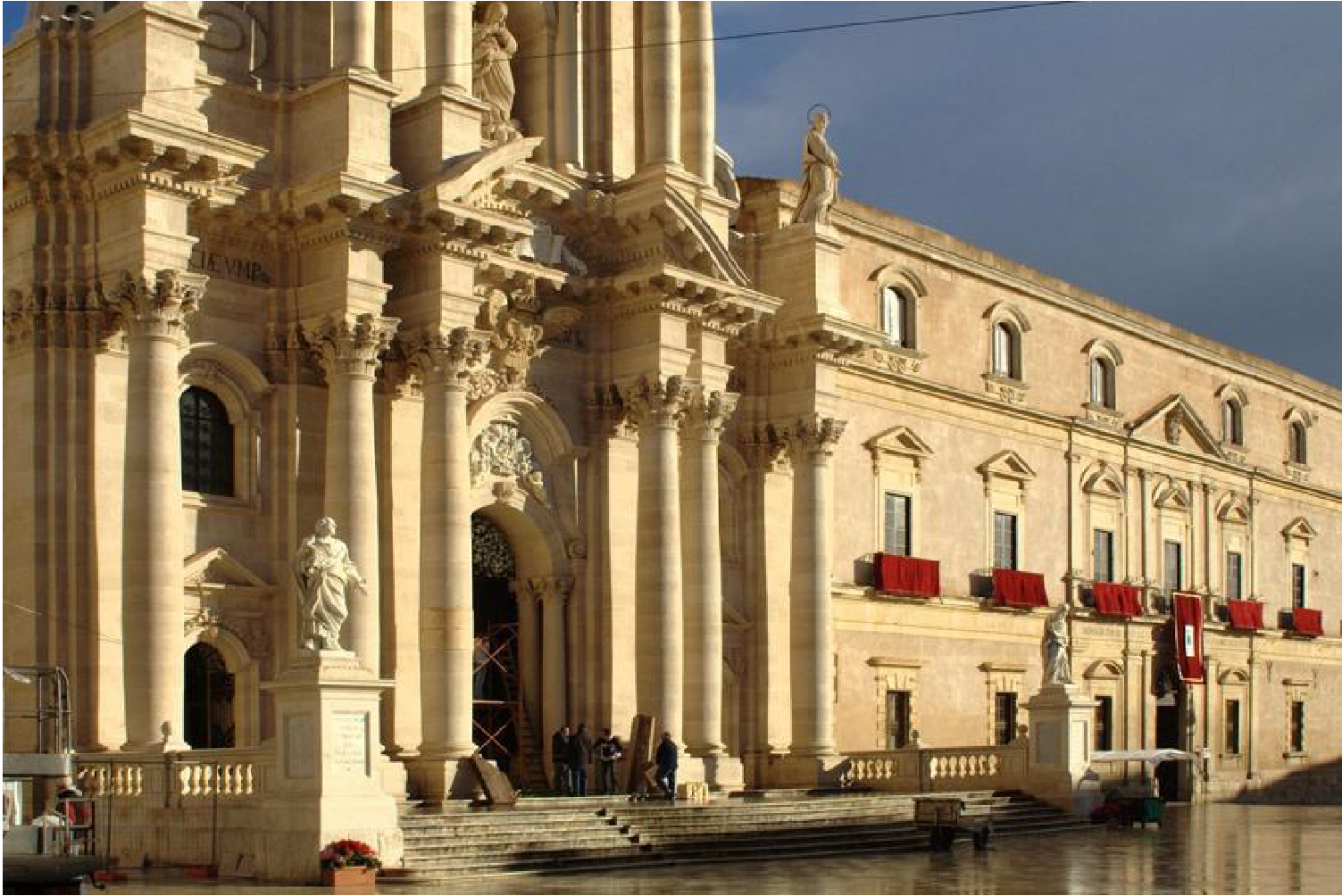
The route continues to Piazza Duomo, a public square shaped by Baroque reconstruction after the 1693 earthquake in southeastern Sicily. On the square stands the Syracuse Cathedral, originally a 5th-century BCE Greek temple dedicated to Athena and later converted into a Christian church; the Doric columns of the ancient temple remain visible in the structure. The tour also passes through Largo Aretusa to reach the Fonte Aretusa, a freshwater spring near the sea associated with the Greek myth of the nymph Arethusa and noted for the presence of papyrus plants growing in its waters.
Frequently asked questions
What is the maximum of participants?
The maximum of participants is 15 people.
Can I pay with something other than PayPal?
Yes, after clicking on “Pay with PayPal” and the PayPal window opens, you will see the option to pay with a debit or credit card.
Can I book a private walking tour?
Yes, you can book a private walking tour by contacting us straight via email.
Can I bring my children?
Yes, in this walking tour in Syracuse everyone is welcome.
What should I bring?
Check out the weather on the day of the tour to make sure you bring an umbrella in case it’s raining. Bring comfortable shoes and a big smile 🙂